
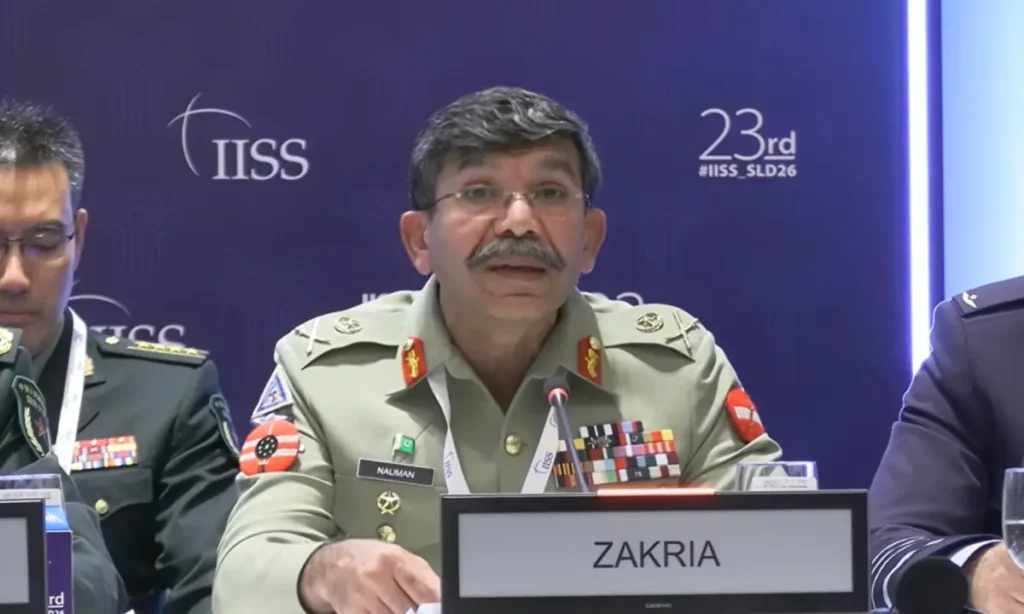
SINGAPORE: A senior Pakistani military official has said Pakistan’s response during the May 2025 India-Pakistan conflict effectively challenged longstanding assumptions about the possibility of limited conventional war in South Asia.
Speaking during a special session at the Shangri-La Dialogue in Singapore, Commander I Corps Lieutenant General Nauman Zakria said the confrontation highlighted the evolving realities of deterrence, crisis management and modern warfare in the region.
“Pakistan’s resolute response has effectively debunked the notion of space for war in South Asia,” the military official said while discussing regional strategic stability.
The May 2025 conflict, which lasted several days, marked one of the most serious escalations between Pakistan and India in decades. The crisis followed heightened tensions after an attack in Indian-administered Kashmir, which New Delhi linked to Pakistan — an allegation Islamabad rejected while calling for an impartial investigation.
According to Lt Gen Zakria, South Asia’s strategic environment continues to be shaped by nuclear deterrence, conventional military asymmetry, unresolved disputes, and persistent political friction between the two nuclear-armed neighbours.
He also pointed to the growing role of multi-domain warfare, saying the conflict demonstrated Pakistan’s ability to conduct integrated operations involving cyber capabilities, electronic warfare, intelligence systems, surveillance platforms and information operations alongside conventional military coordination.
While noting that post-conflict conditions have narrowed the scope for conventional escalation, the official warned that continued militarisation, adversarial rhetoric and weak crisis-management mechanisms remain risks to regional stability.
He stressed the need for stronger communication frameworks, escalation-control mechanisms and greater international focus on responsible governance of emerging technologies in an increasingly volatile geopolitical environment.
The remarks come amid ongoing debate over regional deterrence, military modernisation and the future security architecture of South Asia.